Seventy years after ferrocene baffled the chemistry world, researchers at IIT Madras and IISc Bengaluru have answered the question no one could: can the iconic metal-ring sandwich exist without a single atom of carbon?
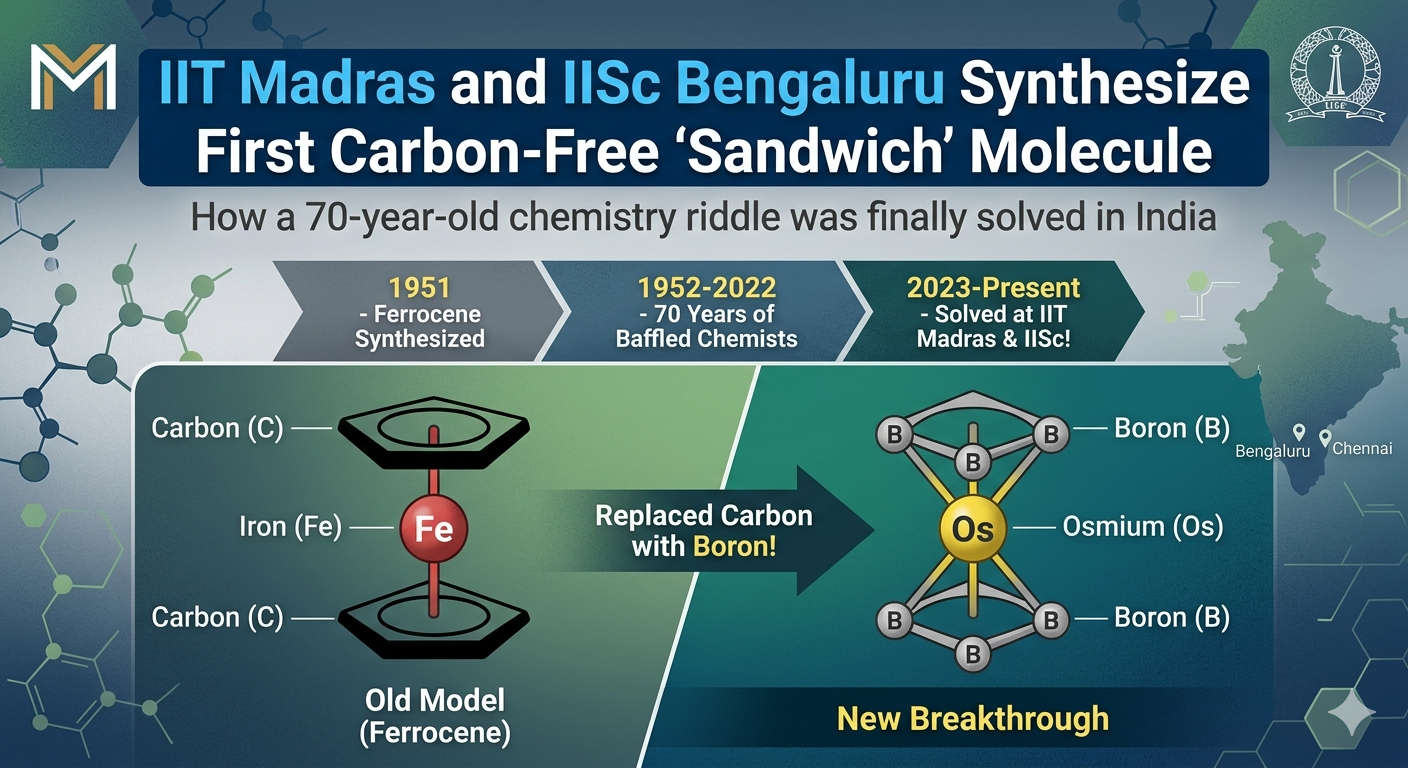
Chemists have long revered ferrocene as one of the most elegant molecules ever discovered. When it was first synthesised in the early 1950s, its bizarre yet beautiful structure — an iron atom nestled perfectly between two flat rings of carbon atoms like meat in a sandwich — upended everything scientists thought they knew about chemical bonding. It won a Nobel Prize in 1973, launched the entire field of organometallic chemistry, and went on to find uses in medicines, batteries, fuel additives, and advanced materials. Yet for all its fame, one profound question haunted the field for seven decades: could such a structure exist without carbon?
Now, researchers at the Indian Institute of Technology Madras and the Indian Institute of Science Bengaluru have answered that question with a resounding yes — and in doing so have created something the chemistry world has never seen before.
The DiscoveryCarbon’s Long-Held Monopoly, Broken
The team, led by Prof. Sundargopal Ghosh and doctoral researcher Stutee Mohapatra from IIT Madras, in close collaboration with Prof. Eluvathingal Jemmis of IISc Bengaluru, synthesised a molecule structurally identical to ferrocene in geometry — but built from entirely different elements. Where ferrocene places an iron atom between two carbon rings, the new molecule substitutes osmium at the centre and employs boron-based rings in place of carbon. The result is a sandwich compound that contains not a single atom of carbon.
“The key scientific question was: could the famous ferrocene structure exist without carbon? Until now, the answer remained uncertain.”
The challenge was formidable. For decades, researchers had attempted to develop ferrocene-like compounds using non-carbon elements, but carbon’s exceptional bonding capability made it extraordinarily difficult to reproduce such stable molecular structures. Boron, carbon’s immediate neighbour on the periodic table, has long been known for its unusual bonding behaviour, but stabilising a five-membered boron ring in the same way carbon rings are stabilised in ferrocene required a metal partner of precisely the right electronic character. The team used computational modelling to determine that osmium — a dense, platinum-group metal — would provide the ideal electronic environment to stabilise the boron rings.
The compound was synthesised by heating precursor chemicals at 100 degrees Celsius for eight hours, yielding a colourless solid whose sandwich structure was subsequently confirmed by X-ray diffraction analysis. The findings were published in the journal Science, one of the most prestigious peer-reviewed publications in the world.
Research Team
Stability & StructureStronger Than the Original?
Perhaps the most striking finding is not merely that the molecule exists, but how robust it appears to be. The molecule exhibits strong bonding between osmium and the boron-based rings. Preliminary studies indicate that it may be as stable as, or even more stable than, conventional ferrocene under certain conditions. This is counterintuitive: boron rings had long been regarded as too reactive and geometrically strained to mimic the celebrated stability of cyclopentadienyl carbon rings. The osmium-boron bond, it turns out, may prove remarkably resilient — and that resilience is where much of the scientific excitement now lies.
Why It MattersThe Future Written in Boron and Osmium
The implications of this discovery reach far beyond resolving an academic puzzle. Ferrocene and its carbon-based descendants have become indispensable workhorses of modern chemistry — used as anti-tumour drug carriers, electrochemical standards in battery research, and scaffolds for industrial catalysts. The new molecule, by demonstrating that stable sandwich structures are possible without carbon, could open fresh possibilities for future materials and technology in ways that are only beginning to be imagined.
Future Importance — Key Domains
- Medicinal Chemistry: Carbon-free metallocenes could offer radically new scaffolds for anti-cancer and anti-infective drugs, avoiding carbon-based toxicity profiles.
- Next-gen Batteries: Boron-based sandwich compounds may act as superior redox mediators in energy storage, pushing beyond current electrochemical limits.
- Industrial Catalysis: Osmium’s unique reactivity could enable catalytic pathways impossible with iron-carbon systems, especially in high-temperature processes.
- Semiconductor Materials: The electron-delocalisation properties of boron rings open new avenues for organic-free electronic materials.
- Fundamental Chemistry: The discovery redefines the very concept of aromaticity and sandwich bonding, rewriting textbooks and inspiring a new generation of non-carbon molecules.
- Heat-resistant Applications: If osmium-boron bonds prove more thermally robust than iron-carbon bonds, entirely new classes of high-performance, high-temperature materials could follow.
There is also a deeper, philosophical importance. Chemistry has long been described as “the science of carbon” — life itself is built on it, and organic chemistry has dominated the field for nearly two centuries. This breakthrough demonstrates that stable sandwich complexes are not exclusive to carbon-based systems, challenging one of the most entrenched assumptions in molecular science. The question is no longer whether carbon-free metallocenes can exist, but how many more are waiting to be found — and what they might do.
For Indian science, the achievement carries additional resonance. Fundamental research of this calibre, published in Science and solving a problem that eluded chemists for over seventy years, signals the deepening strength of India’s research institutions and their capacity to make globally transformative contributions. Prof. Ghosh, Prof. Jemmis, and their teams have not merely answered an old question — they have opened a door into an entirely new wing of chemistry.
If ferrocene rewrote the rules of bonding in the 1950s, the osmium-boron sandwich may rewrite them again — this time, without a single carbon atom in sight.
Leave a Reply