Long before satellites, an invisible compass already existed — written into the bodies of birds, turtles, and bacteria. Here is how life learned to feel the Earth’s magnetic field.
Every spring, a European robin weighing less than a chocolate bar lifts off from North Africa and flies, mostly at night, to a nesting ground in Scandinavia it has never seen. It crosses seas, mountain ranges, and cities without a map, a compass, or a single landmark it recognizes. And yet it arrives. The robin is not guessing. It is reading a field of force that humans cannot perceive at all: the Earth’s magnetic field, generated nearly 3,000 kilometers beneath its feet by the churn of molten iron in the planet’s outer core.
This sense — called magnetoreception — is one of biology’s strangest and most quietly impressive achievements. It has evolved independently in birds, fish, insects, mammals, reptiles, and even bacteria, despite the Earth’s magnetic field being extraordinarily weak: roughly 25 to 65 microtesla at the surface, about 100 times feebler than a typical refrigerator magnet. Detecting something so faint, reliably, with biological tissue, looks almost like a contradiction. Yet across hundreds of millions of years, evolution found at least two, and possibly three, separate physical strategies for doing it.
What the Magnetic Field Actually Offers
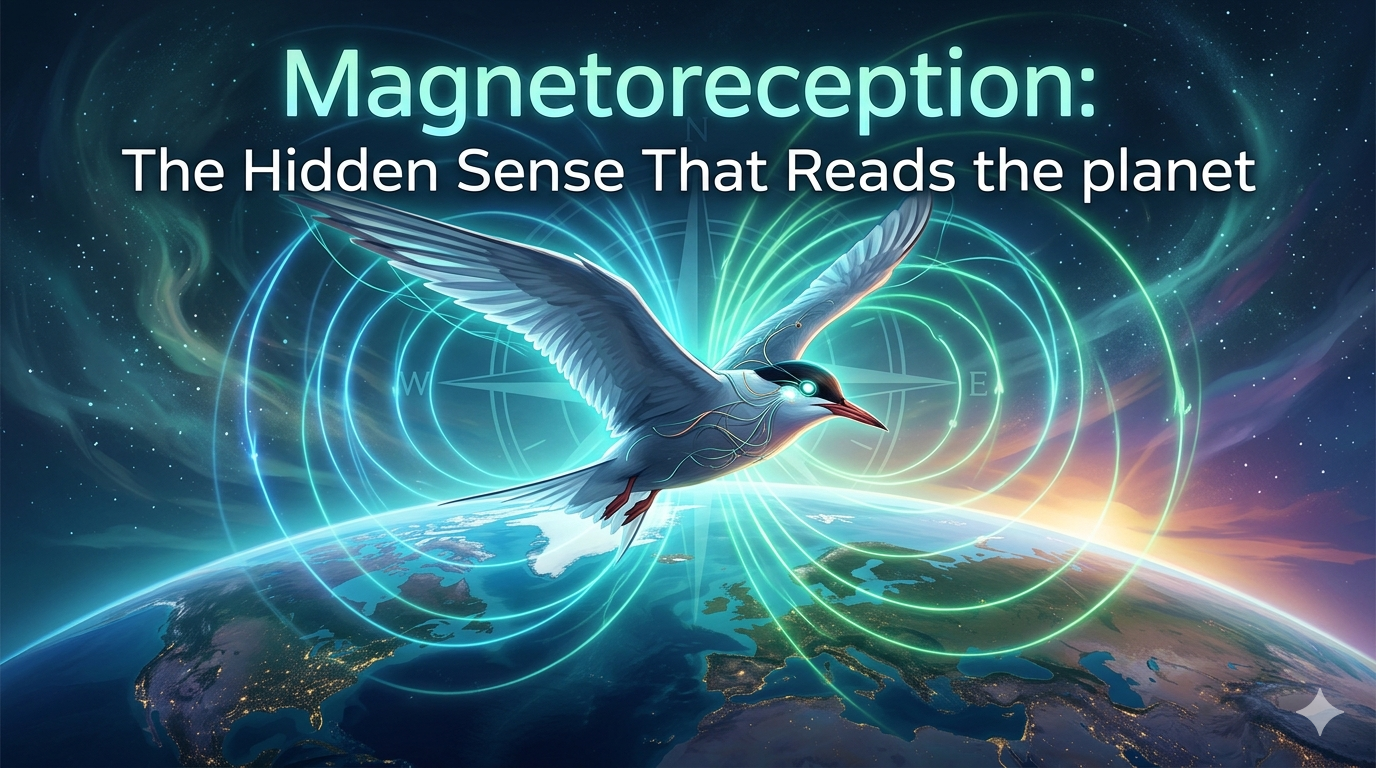
The Earth behaves, very roughly, like a bar magnet tilted about 11 degrees from its rotational axis. Field lines emerge from the magnetic south pole, arc through space, and re-enter near the magnetic north pole. Two properties of this field turn out to be biologically useful.
The first is polarity — simply which way is north and which way is south, the property a compass needle uses. The second, more subtle property is inclination: the angle at which field lines dip into the ground. Near the equator, the lines run nearly parallel to the surface; near the poles, they plunge almost straight down. An animal that can sense this dip angle effectively knows its magnetic latitude, even without knowing compass direction at all. Many migratory species appear to use an “inclination compass” rather than a true polarity compass — they cannot tell magnetic north from south the way a ship’s compass can, but they can tell poleward from equatorward, which is exactly the information needed for a long migratory journey.
Two Rival Mechanisms, One Sense
For decades, the central mystery of magnetoreception was not whether animals could do it — behavioral experiments since the 1960s left little doubt — but how. No dedicated “magnetic organ” analogous to an eye or an ear has ever been found. The leading explanations describe two entirely different kinds of physics happening inside living tissue.
1. The Radical-Pair Compass: Quantum Chemistry in the Eye
The most well-supported mechanism today centers on a light-sensitive protein called cryptochrome, found in the retinas of migratory birds. When blue light strikes cryptochrome, it knocks an electron loose, briefly creating a pair of molecular fragments called a radical pair — each carrying an unpaired electron whose spin can point in one of two quantum states. Crucially, the external magnetic field subtly influences how long these spin states persist and which chemical product the reaction favors.
Because the Earth’s field tilts the molecule’s spin dynamics depending on orientation, the rate and outcome of this fleeting chemical reaction effectively varies with compass heading. Recent computational work from Princeton researchers, published in late 2025, mapped the electron transfer pathway inside avian cryptochrome-4a in unusually fine detail, showing how surrounding amino acids stabilize the radical pair long enough for it to function as a working sensor. The favored candidate protein, cryptochrome-4a, is concentrated in light-sensing cone cells of the bird retina — meaning a migrating bird may, in some sense, see the magnetic field as a faint pattern overlaid on its ordinary vision, rather than feeling it as a separate sensation.
This explains several odd behavioral facts that puzzled researchers for years: the avian magnetic compass only works in the presence of certain wavelengths of light, it is disrupted by weak radio-frequency fields tuned to a very specific frequency, and it reads inclination rather than polarity — all signatures consistent with a light-driven, spin-based chemical reaction rather than a simple metallic needle.
- The Earth’s magnetic field at its surface is roughly 25–65 microtesla — about 100 times weaker than a standard fridge magnet.
- Cryptochrome proteins linked to magnetoreception are also found in the human eye and are involved in regulating our circadian rhythm, though no functional magnetic sense has been confirmed in people.
- The radical-pair mechanism may depend on quantum spin coherence lasting only a few microseconds — yet that is long enough to extract directional information.
- Sea turtle hatchlings can sense both magnetic inclination and intensity, letting them build a mental “magnetic map” of the open ocean.
2. The Magnetite Hypothesis: A Built-In Compass Needle
The second proposed mechanism is more mechanical than chemical. Many magnetically sensitive animals — including trout, mole rats, and homing pigeons — contain microscopic crystals of magnetite (Fe₃O₄), a naturally occurring magnetic mineral, embedded in nerve tissue, often near the nose, inner ear, or upper beak. Because magnetite is genuinely ferromagnetic, even a few dozen properly arranged crystals could, in principle, twist or tug in response to an external field, physically deforming attached nerve fibers and generating a directional signal in much the same way mechanical pressure receptors work.
Unlike the radical-pair mechanism, a magnetite-based compass would not require light at all and could, in theory, sense both polarity and field intensity — explaining why some species seem able to detect not just direction but their approximate position on a magnetic “map,” useful for true long-distance navigation rather than a simple compass bearing. A 2026 proposal published in PNAS goes further, suggesting a hybrid model in which tiny magnetite particles sit near radical-pair molecules and locally amplify the weak geomagnetic field to roughly 100 times its natural strength, potentially making the chemical radical-pair sensor far more sensitive than it could be acting alone.
The two mechanisms are not necessarily rivals. Growing evidence suggests that birds, in particular, may run both systems in parallel: a light-dependent compass in the eye for setting direction, and a separate magnetite-based system, possibly in the upper beak or inner ear, for sensing position — two different instruments serving two different navigational questions.
A Sense Found Across the Tree of Life
Magnetoreception is not a rare evolutionary curiosity confined to a handful of migratory birds. Versions of it appear, independently evolved, across an extraordinarily wide range of organisms.
European Robin (Erithacus rubecula)
The most extensively studied case of a light-dependent inclination compass, active in the retina.
Loggerhead Sea Turtle (Caretta caretta)
Hatchlings imprint on the magnetic signature of their home beach and can find it again decades later.
Honeybee (Apis mellifera)
Uses magnetic cues to help calibrate the famous waggle dance and orient honeycombs.
Naked Mole Rat (Heterocephalus glaber)
A blind burrower that still uses an internal magnetic compass to orient its underground tunnels.
Magnetoreception even reaches into the microbial world. So-called magnetotactic bacteria, found in lake sediment and shallow marine mud, grow internal chains of magnetite crystals called magnetosomes. These act as literal compass needles, passively aligning the bacterium’s whole body with the Earth’s field so it can swim efficiently toward the oxygen-poor mud layers it prefers — magnetoreception’s simplest and most ancient known form, requiring no nervous system at all.
Why It’s So Hard to Study
Magnetoreception has resisted easy discovery for a simple reason: there is no obvious external organ to point to. Vision has an eye, hearing has an ear with visible internal structure, but no animal has ever been found with a similarly conspicuous “magnetic organ.” Candidate tissues are microscopic, mechanistically subtle, and in the case of the radical-pair model, depend on quantum effects that are inherently delicate and easily disrupted by experimental handling. Behavioral evidence has often run years ahead of mechanistic proof, with researchers confident animals could sense magnetic fields long before they had any plausible account of how.
That gap has narrowed substantially over the past two decades. Improved cryo-electron microscopy, spectroscopy of isolated cryptochrome proteins, and large-scale computational modeling of radical-pair spin dynamics have together turned what was once an almost philosophical puzzle into an active, increasingly quantitative field of biophysics — one of the few corners of biology where quantum mechanics is treated not as a metaphor, but as a working explanatory tool.
Cryptochrome-4a is currently the leading candidate magnetoreceptor molecule in migratory birds. It is concentrated in the outer segments of double-cone and long-wavelength cone photoreceptor cells in the retina, and its expression rises specifically during migratory season — a strong hint that it is functionally tied to navigation rather than ordinary vision.
An Open Question, Still
No one mechanism has yet been proven beyond doubt, and the truth may simply be plural: different lineages, facing different ecological problems, may have converged on different physical solutions to the same challenge of reading an invisible field. A migratory songbird, a homing pigeon, and a deep-sea bacterium are not necessarily using the same trick — they may be running entirely separate pieces of physics, in different tissues, toward the same end.
What remains consistent is the scale of the achievement. The animals doing this are not equipped with anything resembling a ship’s compass. They are extracting directional information from a field one-hundredth the strength of a kitchen magnet, using biological molecules a few nanometers across, operating at temperatures and in chemical environments that should, by ordinary intuition, scramble anything as fragile as a quantum spin state almost instantly. That they manage it at all — reliably enough to fly continents, find a single beach after decades at sea, or orient a tunnel system in total darkness — remains one of the more quietly extraordinary facts in all of biology.

Leave a Reply