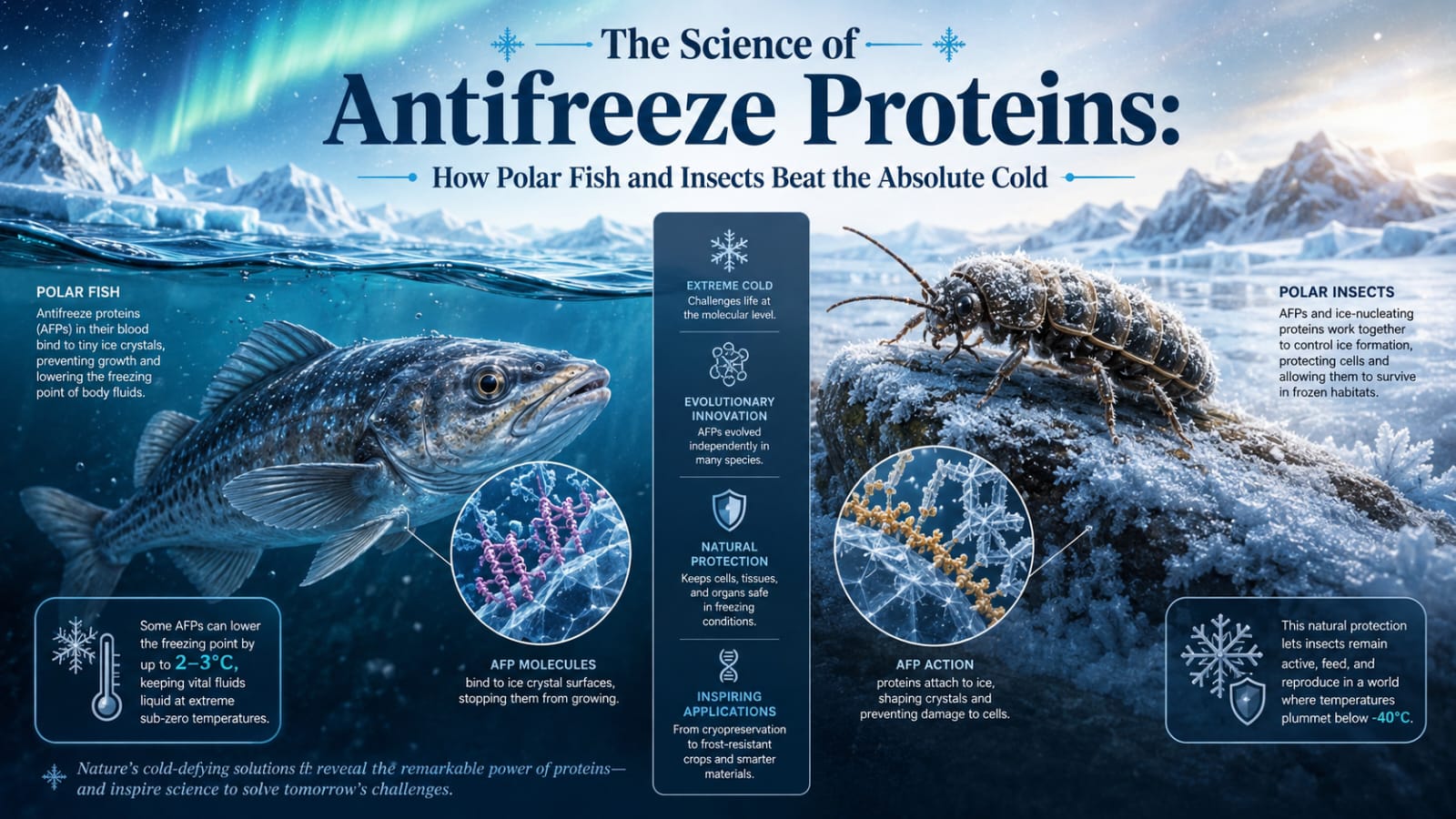
Deep inside the blood of a polar cod and the gut fluid of a mealworm beetle, the same molecular trick keeps water liquid at temperatures that should freeze it solid — not by lowering the freezing point like a chemical, but by physically arresting ice one crystal face at a time.
Illustration — antifreeze proteins (coral) docking onto the prism face of a forming ice crystal, arresting its growth before it can spread through the bloodstream. The same molecular strategy independently evolved in polar fish and cold-hardy insects.
In the Arctic Ocean, seawater hovers around −1.9 °C through the long winter — cold enough to freeze the blood of almost any fish on Earth. And yet bottom-dwelling cods, sculpins, and snailfish swim through it unharmed, their blood plasma loaded with a class of molecule that has no equivalent in human chemistry: a protein that stops ice in its tracks not by changing water’s chemistry, but by physically jamming the machinery of crystal growth itself.
These molecules are called antifreeze proteins, or AFPs, and a related group called antifreeze glycoproteins, or AFGPs. They were first inferred from blood-freezing experiments on Arctic fish by the Norwegian physiologist Per Scholander in 1957, then isolated a decade later by Arthur DeVries while studying Antarctic notothenioid fish — a sequence of discoveries that, decades on, turned out to describe just one branch of a much larger evolutionary story. The same basic strategy independently appears in overwintering beetles, moths, midges, springtails, certain frogs, and even snow mold fungi. Wherever life has needed to survive subzero conditions without simply freezing solid, something resembling an antifreeze protein has tended to show up.
01 A Problem Salt Alone Can’t Solve
Seawater freezes at about −1.9 °C because of its dissolved salts — colder than fresh water, but still warmer than the temperature many polar fish actually experience. A typical bony fish’s own blood, by contrast, freezes around −0.7 °C, since its internal salt concentration is lower than seawater’s. That gap is the entire problem: any ice crystal that enters the fish’s body from the surrounding water has every thermodynamic reason to keep growing, because the fish’s own blood is “warmer” than the ice’s growth point. Without intervention, a single ice crystal touching gill tissue could seed catastrophic, full-body freezing within minutes.
The textbook fix for freezing — used in everything from car radiators to runway de-icing — is colligative: dissolve more stuff in the water, and the freezing point drops in proportion to how much you’ve added. Fish could theoretically survive by loading their blood with extra salts or sugars, but the concentrations needed would wreck their internal chemistry long before they wrecked the ice. Antifreeze proteins solve the problem a completely different way. They are non-colligative: present at roughly 1/300th to 1/500th the concentration that salt or sugar would require for the same effect, because they don’t lower the freezing point through simple chemistry at all. They go straight for the ice crystal itself.
Ordinary antifreeze (ethylene glycol, salt): works by colligative depression — more dissolved particles mechanically interfere with water’s ability to form an ordered lattice, lowering the freezing point in direct proportion to concentration.
Biological antifreeze proteins: work by binding directly and almost irreversibly to the surface of tiny ice crystals already present, physically blocking the points where new water molecules would otherwise attach and grow the crystal — at a tiny fraction of the concentration.
02 Adsorption-Inhibition: Ice-Binding in Slow Motion
The mechanism has a clinical name — adsorption-inhibition — that undersells how strange it actually is. An antifreeze protein folds so that one flat face of its structure is studded with a precise, repeating array of polar amino acid residues, usually threonine, arranged at intervals that happen to match the spacing of oxygen atoms on an ice crystal’s surface. That ice-binding face attaches to specific crystal faces through a combination of hydrogen bonds and van der Waals forces, and once it locks on, it reshapes the boundary between solid ice and surrounding liquid water into a curve.
That curvature is the whole trick. Ice wants to grow as flat crystal planes, because flat surfaces are thermodynamically efficient for adding new water molecules. Force the surface into a curve instead, and growth becomes energetically unfavorable at that point — a phenomenon related to the Gibbs-Thomson effect, familiar from how small water droplets resist freezing more than large ones. The protein doesn’t melt the ice it’s attached to. It simply pins the crystal at sub-microscopic points across its surface, so densely that the remaining ice front can’t advance without bulging outward into a curve too sharp to sustain. Growth stalls — until the temperature drops far enough to overpower even that.
Thermal Hysteresis: A Gap Between Freezing and Melting
Because AFPs work on the crystal surface rather than the surrounding water chemistry, they create an odd asymmetry that’s almost a signature of biological antifreeze: the temperature at which an AFP-protected ice crystal will grow drops well below the temperature at which an existing ice crystal will melt. Polar fish blood normally has an equilibrium freezing and melting point of about −0.7 to −1.0 °C, but with antifreeze proteins bound to any stray ice, the non-equilibrium point at which that ice will actually resume growing can be pushed several degrees lower. Biologists call the gap between these two points thermal hysteresis, and it’s the standard lab measurement used to compare antifreeze potency across species.
POLAR SEAWATER
IN FISH AFPs
VS. FISH AFPs
03 Four Lineages, One Solution: Fish Antifreeze
Polar fish antifreeze proteins fall into several structurally distinct families — conventionally labelled Types I through IV, plus the glycosylated AFGPs — and the remarkable part is that they don’t share a common ancestor. At least four separate fish lineages — flounders, sculpins, cunners, and snailfish — independently evolved their own version of Type I antifreeze protein when Northern Hemisphere glaciation intensified roughly two to three million years ago, each starting from a different genetic point of origin and arriving at a similar functional answer. It’s convergent evolution at the molecular level: the ocean cooled, freezing became survivable only with help, and natural selection found the same trick more than once.
One of the best-documented origin stories belongs to northern cod. Researchers traced its antifreeze gene back to a short stretch of noncoding DNA — just nine nucleotides — that duplicated repeatedly until it formed a long run of repeats coding for a recurring three-amino-acid unit built around threonine. Whether that duplicated sequence ever became a functioning, helpful protein depended on whether the surrounding genetic context allowed it to be transcribed and translated at all — and once it did, and once it happened to improve survival in icy water, natural selection fixed it permanently into the population’s genome. In other words: this antifreeze gene wasn’t repurposed from something else. It was built from genetic scratch, essentially from noise, because the cold demanded a solution and eventually one assembled itself.
Antarctic notothenioid fish, the dominant fish group around Antarctica, took the more conventional evolutionary route: their antifreeze glycoproteins are believed to have evolved from a pre-existing, non-antifreeze gene through a combination of exon shuffling, duplication, and divergence of originally nonfunctional DNA segments. In notothenioids, the glycoprotein’s job appears to have started out narrow — antifreeze activity confined to intestinal fluid — before later expanding to expression in the liver and release into the wider bloodstream, turning a local fix into a body-wide one.
The Strange Cost: Ice That Won’t Melt
For decades, biologists assumed antifreeze proteins only worked in one direction — stopping ice from growing. Then researchers studying Antarctic fish found something that shouldn’t happen in normal physics: the same proteins that block freezing also block melting, so the same tiny ice crystals can persist inside a fish’s body for its entire life, sitting at temperatures technically above their melting point — a phenomenon called superheating, previously known only from controlled laboratory conditions.
That creates an evolutionary trade-off with real teeth. A long-term temperature record of high-latitude Antarctic fish habitat shows that the warming these fish experience each summer is not enough to reliably eliminate the internal ice their own antifreeze proteins are protecting, meaning the very adaptation that lets notothenioids survive winter also commits them to carrying potentially damaging ice crystals for the rest of their lives. It’s a textbook case of antagonistic pleiotropy — a single gene doing one job brilliantly while quietly creating a different, harder-to-solve problem on the side.
04 The Insects That Out-Engineer Fish
If fish antifreeze proteins are a clever solution, insect antifreeze proteins are an engineering flex. In 1997, researchers purified a thermal hysteresis protein from the yellow mealworm beetle, Tenebrio molitor, with up to 100 times the specific antifreeze activity of fish proteins by weight — a threonine- and cysteine-rich molecule of about 8,400 daltons, built largely from repeating 12-amino-acid units. At a concentration of roughly one milligram per millilitre, this single protein could account for the full 5.5 °C of thermal hysteresis measured in living Tenebrio larvae — a gap several times wider than what any fish protein achieves at comparable concentrations.
The structural reason insect AFPs hit so much harder than fish AFPs comes down to geometry. In Tenebrio and the closely related Dendroides beetles, each 12-to-13-amino-acid repeat is locked in place by an internal disulfide bond, and six to ten of these repeats coil together into a beta-solenoid structure with one completely flat ice-binding face made of a double row of threonine residues. A different beetle genus, Rhagium, independently produces a related but distinct AFP with longer repeats, no internal disulfide bonds, and four rows of threonine instead of two — arranged in a folding pattern that, remarkably, converges on a similar overall shape to the completely unrelated antifreeze protein found in the pale beauty moth. More ice-binding surface, locked rigidly in place by chemical bonds the fish proteins don’t use, translates directly into a flatter, more extensive grip on the ice crystal — and a correspondingly larger thermal hysteresis gap.
Polar fish live in water that bottoms out around −1.9 °C. Overwintering insects face a much harsher reality — during extreme winter conditions, the spruce budworm resists freezing at temperatures approaching −30 °C, a margin no fish antifreeze protein could cover. Insect AFPs evolved their “hyperactive” extra potency because the cold they’re up against is simply colder.
Springtails: A Different Blueprint Entirely
Not every cold-hardy arthropod reaches for the threonine-rich beta-solenoid playbook. Snow fleas — tiny six-legged springtails common in Canada, which are arthropods but not technically insects — produce their own hyperactive antifreeze protein built almost entirely differently: around half its amino acids are glycine, arranged in short repeating units that each form one turn of a polyproline helix, with two of these helices folding together into a bundle whose ice-binding face is dominated by small hydrophobic alanine residues rather than threonine. It’s the same engineering problem solved with an entirely different parts catalog — further evidence that “antifreeze protein” describes a function that evolution keeps reinventing, not a single ancestral design being passed down.
05 Freeze-Avoidant vs. Freeze-Tolerant: Two Different Bets
Cold-climate animals split into two broad survival strategies, and antifreeze proteins play a different role in each. Freeze-avoidant species use AFPs to prevent their body fluids from freezing at all — though if temperatures drop low enough to overwhelm the protein’s protective ceiling, the result is typically sudden, catastrophic ice growth and death rather than a graceful failure. Freeze-tolerant species take the opposite gamble: they allow at least some of their body fluids to freeze and survive the experience, using antifreeze proteins less to stop ice altogether and more as cryoprotectants — likely inhibiting damaging ice recrystallization and helping stabilize cell membranes against the physical stress of freezing, although the exact protective mechanism here is still not fully resolved.
| Strategy | How AFPs Are Used | Risk Profile | Example Organisms |
|---|---|---|---|
| Freeze-avoidant | Block ice growth entirely; body fluids stay liquid throughout winter | Catastrophic, sudden freezing if cold exceeds the protein’s ceiling | Polar cod, notothenioid fish, many beetles |
| Freeze-tolerant | Allow controlled freezing; AFPs limit ice recrystallization and crystal size | Cellular stress from freeze-thaw cycling, but survivable in increments | Certain wood frogs, some midges, select moth larvae |
Many cold-hardy insects also pair their antifreeze proteins with a second class of molecule — ice nucleator proteins — that work in the opposite direction, deliberately triggering ice formation at a controlled, relatively mild temperature so that freezing happens gradually in extracellular spaces rather than abruptly and destructively inside cells. It’s a genuinely odd division of labor: one protein invites the ice in on the organism’s own terms, while the other makes sure it doesn’t go any further than it’s told to.
06 Independent Convergence: Nature’s Repeated Answer
Strip away the species-specific details and a pattern emerges that’s almost suspicious in its consistency. Structural studies on an Arctic yeast in the genus Leucosporidium found that antifreeze proteins from fish, plants, and insects all share similarly hydrophobic, consistent ice-binding domains — even though the overall protein folds carrying those domains differ significantly from one lineage to the next. Fish use beta-helices and AFGP’s repeating glycopeptide chains. Beetles use disulfide-locked beta-solenoids. Moths use flat silk-like beta-helix folds. Springtails use glycine-rich polyproline bundles. The folds are all different — but the functional logic, a flat, ordered, hydrophilic surface that locks onto an ice lattice, keeps reappearing.
07 From Polar Blood to the Operating Room
The same molecular trick that keeps a sculpin’s blood liquid is now one of the more promising leads in transplant medicine. Standard cold storage keeps a donated heart viable for only a handful of hours, and full cryopreservation of whole organs remains impossible today because ice formation at subzero temperatures destroys the very tissue it’s meant to preserve. The biomedical hope is that biocompatible antifreeze compounds could enable safe subzero storage without that damage — buying time for tissue matching, transport, and recipient preparation that current methods simply don’t allow.
Researchers at the University of New Hampshire are specifically exploring antifreeze proteins as a possible replacement for DMSO, the chemical cryoprotectant currently used to freeze cells and tissue, which can trigger adverse reactions in patients and may inadvertently affect how certain stem cells differentiate. Parallel work out of Eindhoven University of Technology has gone further, using super-resolution microscopy to directly visualize individual antifreeze proteins binding to ice at subzero temperatures for the first time, and showing that the proteins’ key ice-blocking properties can be transferred into synthetic polymers — a step that opens the door to manufacturing AFP-like materials at industrial scale rather than extracting them from fish or insects one batch at a time.
The same proteins are being explored for frost-resistant crop engineering, smoother-textured frozen food, and — more speculatively — long-duration cryopreservation relevant to extended space travel, where the cold-survival problem facing a hibernating astronaut isn’t so different, in principle, from the one facing a fish in the Arctic Ocean.
08 What the Ice Can’t Explain on Its Own
It’s worth sitting with how strange thermal hysteresis really is, once you strip away the biology. A protein, at vanishingly low concentration, creates a measurable temperature range inside which ice simply refuses to grow or shrink — not because the chemistry of water has changed, but because a handful of molecules have mechanically pinned the geometry of a crystal’s surface. Early hypotheses assumed hydrogen bonding between the protein’s hydroxyl groups and the surrounding water had to be doing the heavy lifting, but mutant flounder proteins stripped of every threonine residue — and therefore every relevant hydroxyl group — behaved almost identically to the unmodified protein, undercutting that explanation and pointing toward a more purely physical, shape-based mechanism instead.
That unresolved edge is, in its own way, the most honest part of the story. Researchers can describe what antifreeze proteins do with precision — bind here, curve the interface there, create this many degrees of hysteresis — while the deepest question of exactly why the binding is so effective, and why some folds achieve hyperactivity while structurally similar ones don’t, remains an active research problem rather than a settled answer. The fish and the beetles solved it long before any laboratory did. We’re still catching up to molecules that have been quietly keeping blood liquid in subzero water for millions of years.


Leave a Reply