Feeding a Burning Planet
How global warming is forcing humanity to reimagine what we eat, how we grow it, and whether our food systems can survive the century ahead.
For ten thousand years, human civilization has been built on a single assumption: that the climate would remain stable enough to grow food. That assumption is now in ruins. As global temperatures climb to levels not seen in millions of years, droughts devastate harvests, floods drown crops, and traditional farming calendars fall out of sync with a world that is changing faster than farmers can adapt.
The crisis is not on the horizon — it is here. From the parched wheat fields of India to the disappearing glaciers that once fed Andean rivers, the global food system is already straining under the weight of a warming world. Feeding the estimated 9.7 billion people expected to inhabit Earth by 2050 will require nothing less than a complete reinvention of how food is grown, distributed, and consumed.
Global Warming by the Numbers — The Facts That Should Frighten Us
- 🌡️+1.3°C and rising: Earth’s average surface temperature has already risen by approximately 1.3°C above pre-industrial levels. Scientists warn that even 1.5°C could push 14% of Earth’s species toward extinction.
- 🌾Crop yields collapsing: For every 1°C rise in temperature, global yields of wheat fall by 6%, rice by 3.2%, maize by 7.4%, and soybean by 3.1% — the four crops that feed most of humanity.
- 🌊830 million at risk: If sea levels rise by just 1 metre — a realistic scenario by 2100 — over 830 million people living in coastal agricultural zones could be displaced, wiping out vast productive farmland.
- 🐝Pollinators vanishing: Climate change has reduced bee habitats by up to 300 km in North America and Europe. Since bees pollinate 70% of our food crops, their decline is an existential threat to food production.
- 💧2 billion face water scarcity: Over 2 billion people currently live in water-stressed regions. By 2050, climate change could force up to 216 million people to migrate within their own countries largely due to drought and crop failure.
- 🔥Wildfire seasons expand: Wildfire seasons are now 20% longer globally than in the 1980s. In 2023 alone, wildfires destroyed an estimated 9 million hectares of agricultural and forested land worldwide.
- 🥵Deadly heat for farm workers: By 2050, outdoor agricultural workers in South Asia and Sub-Saharan Africa could face potentially lethal heat stress conditions for 250+ days per year under high-emissions scenarios.
01How Our Plates Are Already Changing
The global food crisis is not merely a future scenario — it is quietly reshaping dinner tables around the world right now. Prices of staple foods like wheat, rice, and cooking oils have become increasingly volatile, driven by extreme weather events that hammer harvests with greater frequency. The 2022 global food price spike — triggered partly by drought in key growing regions — offered a grim preview of what lies ahead.
Nutritionists and climate scientists increasingly agree that a planetary shift toward plant-based and climate-resilient diets is not just desirable but necessary. The livestock industry accounts for roughly 14.5% of all global greenhouse gas emissions, making meat-heavy diets a significant driver of the very crisis threatening food supplies. A cruel irony: the way many people eat today is accelerating the conditions that will make eating that way impossible tomorrow.
“We cannot solve the climate and food crisis separately — the way we eat is both a cause of warming and one of our most powerful tools for addressing it.”
Emerging on menus worldwide are millet, sorghum, and ancient grains that evolved to handle heat and drought. Insects as protein sources — long consumed across Asia and Africa — are gaining mainstream attention in Europe and the Americas. Seaweed farming, which requires no freshwater and absorbs carbon, is exploding across coastal East Asia. The plate of the future looks very different from the plate of the past.
- Reducing red meat consumption — shifting toward legumes, pulses, and plant proteins that require a fraction of the land and water.
- Eating locally and seasonally — reducing food miles and the carbon cost of refrigerated global supply chains.
- Embracing forgotten crops — millets, amaranth, teff, and moringa are drought-tolerant, nutritious, and increasingly essential.
- Cutting food waste — approximately one-third of all food produced globally is wasted, representing 8% of total greenhouse gas emissions.
- Insect protein — crickets and mealworms produce 80 times less methane than cattle per kilogram of protein, and conversion rates of feed to body mass are dramatically more efficient.
02Hydroponics — Growing Without Soil
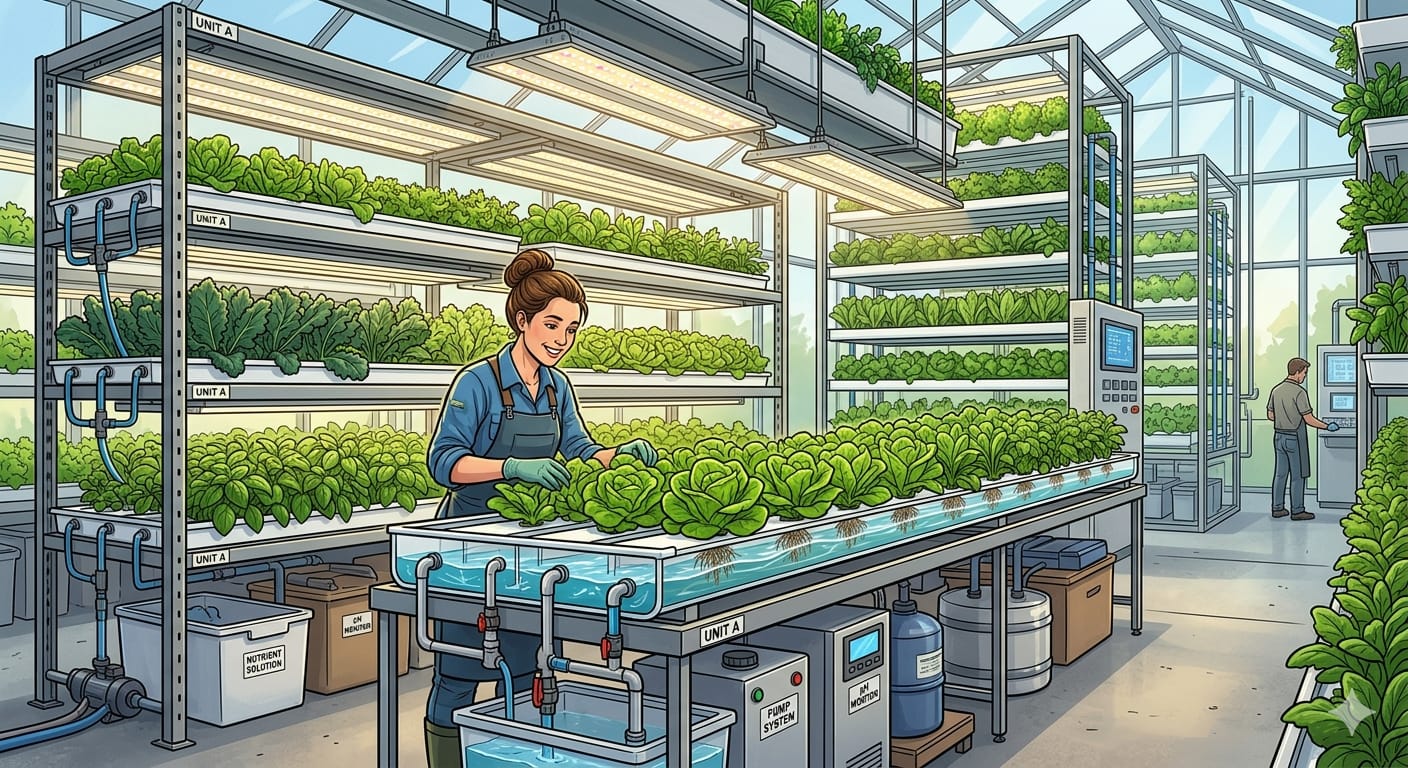
Soil degradation is one of the hidden crises of climate change. Desertification, salinisation from rising seas, erosion driven by extreme rainfall, and the depletion of nutrients through industrial farming have put an estimated 33% of the world’s topsoil at risk. In response, hydroponics — the practice of growing plants in nutrient-rich water without soil — has surged from a niche technology into a mainstream agricultural movement.
In hydroponic systems, plant roots are suspended in or regularly bathed by a carefully calibrated nutrient solution. Without soil as an intermediary, plants can absorb nutrients far more efficiently, growing up to 50% faster than their soil-grown counterparts. Water use is reduced by up to 90% compared to conventional farming — a critical advantage as freshwater scarcity intensifies across the globe.
From rooftops in Mumbai to warehouses in the Netherlands, hydroponic farms are producing lettuce, herbs, tomatoes, and strawberries year-round, regardless of the weather outside. Countries like Israel, where arid conditions have long demanded agricultural innovation, have become global leaders in hydroponic technology, exporting expertise to regions newly confronting drought.
03Vertical Farming — Cities Feed Themselves
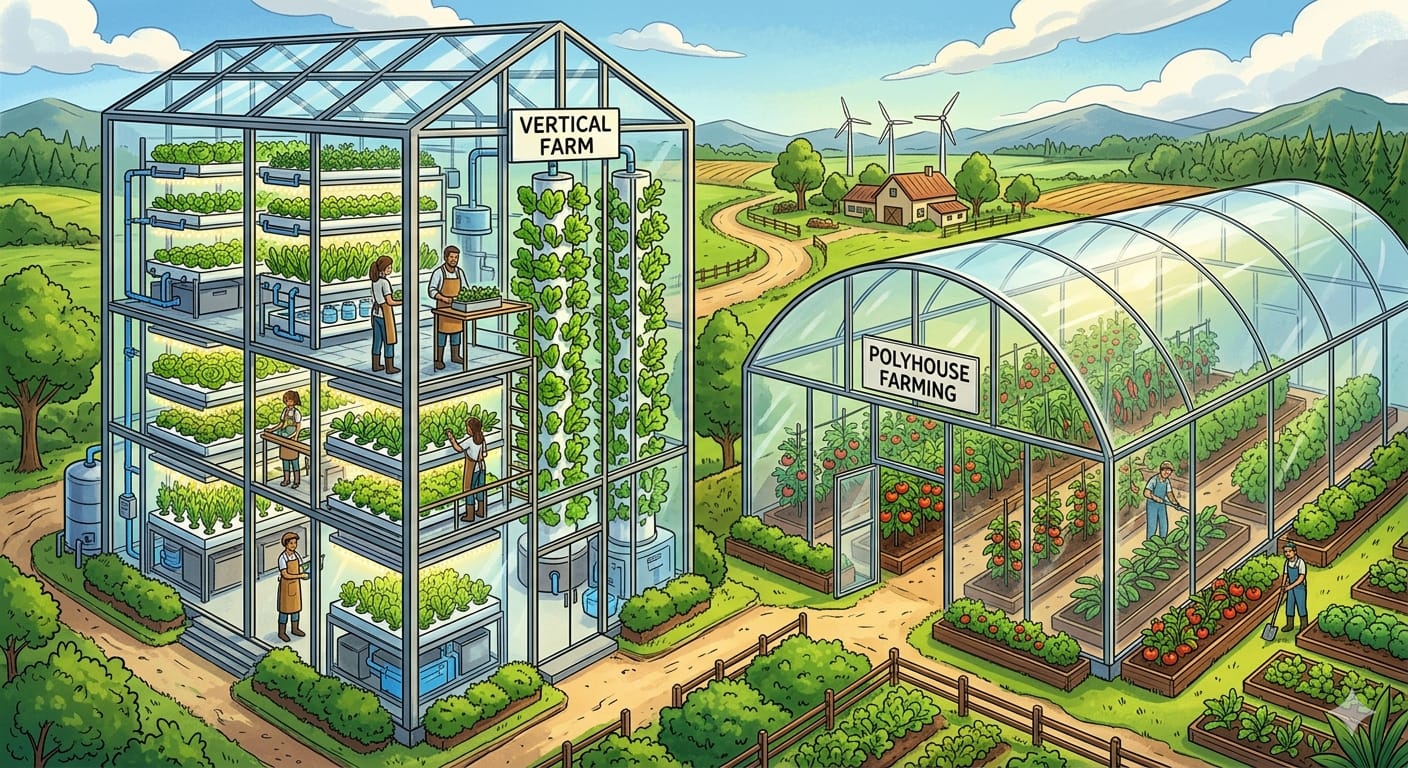
If hydroponics liberates agriculture from soil, vertical farming liberates it from land. In vertical farms, crops are grown in stacked layers inside climate-controlled buildings, illuminated by LED lights tuned to the precise wavelengths plants need for photosynthesis. A single vertical farm occupying one acre of urban land can produce the equivalent of dozens of acres of traditional farmland — with zero dependence on weather, seasons, or arable soil.
The logic is compelling in a world where climate change is increasingly rendering agricultural land unproductive, and where over 68% of the global population is projected to live in cities by 2050. Bringing food production into the city itself slashes transportation emissions, eliminates the need for refrigerated long-distance shipping, and puts fresh produce in neighborhoods that have long lacked access to it.
Companies like AeroFarms in the United States, Bowery Farming, and numerous Chinese ventures have built large-scale vertical farms capable of producing tens of thousands of kilograms of leafy greens per month. In Japan, where arable land is scarce and elderly rural farming populations are declining, vertical farming has been embraced as a national food security strategy. Singapore, which imports over 90% of its food, is investing heavily in vertical farms as a climate resilience measure.
04Polyhouse & Greenhouse Farming — A Shield Against the Sky
For farmers who cannot afford high-tech vertical farms but can no longer trust the open sky, polyhouse farming offers a crucial middle path. A polyhouse — also called a greenhouse or polytunnel — is a structure covered in transparent polyethylene film or glass that creates a controlled microclimate inside. Rain, hail, frost, scorching heat, and wind are shut out; temperature, humidity, and irrigation are managed within.
Across India, Kenya, Morocco, and southern Europe, polyhouse adoption has accelerated sharply as weather unpredictability has intensified. Indian farmers, once entirely dependent on monsoon rains whose timing and intensity have become increasingly erratic, are turning to polyhouses to produce high-value vegetables and flowers regardless of what the sky does outside. Government subsidies in states like Maharashtra, Karnataka, and Himachal Pradesh have helped small and marginal farmers access the technology.
Modern polyhouses are equipped with drip irrigation, automated ventilation, and sensors that monitor soil moisture and temperature in real time. Yields inside polyhouses can be three to eight times higher than open-field cultivation, water use is slashed by 40–60%, and crop losses to extreme weather events are dramatically reduced. As climate unpredictability grows, the polyhouse is becoming less a luxury and more a necessity.
Hydroponics
Soil-free cultivation in nutrient water. Uses 90% less water, grows crops 50% faster, and can be set up anywhere from warehouses to rooftops.
Vertical Farming
Stacked crop layers in urban buildings with LED lighting. Produces equivalent of 30+ acres per acre footprint, entirely weather-independent.
Polyhouse / Greenhouse
Covered structures that shield crops from extreme weather. Yields 3–8× higher than open fields; accessible to small and marginal farmers.
Aquaponics
Combines fish farming with hydroponics in a closed loop. Fish waste fertilises plants; plants clean the water. Near-zero waste system.
05The Road Ahead — A Race We Cannot Afford to Lose
The transition to climate-resilient food systems is not optional. The question is whether it happens in an organised, equitable, and timely manner — or through the chaos of cascading crises. Every year of delay makes the task harder and more expensive. Every fraction of a degree of additional warming narrows the window of viable agricultural options.
The encouraging truth is that solutions exist. Hydroponics, vertical farming, and polyhouse cultivation are proven technologies, not speculative dreams. Dietary shifts toward plant-based and climate-resilient foods can dramatically reduce agriculture’s own contribution to the warming that threatens it. Policy frameworks — from carbon pricing to subsidies for sustainable farming — can accelerate the transition at scale.
But technology and policy alone will not be enough without the most important ingredient: urgency. Governments, corporations, farmers, and consumers all have roles to play. The food system that will feed humanity through the 21st century does not yet fully exist. It must be built — deliberately, quickly, and with the full understanding that the stakes are nothing less than civilisation itself.
“Agriculture is the largest human enterprise on Earth, and transforming it is the most important project of our time. The planet will not wait for consensus — and neither should we.”
The seeds of that transformation are already being planted — in hydroponic farms in Singapore, in polyhouses on Indian hillsides, in vertical farms rising between skyscrapers in Chicago, and in the choices of millions of people who are beginning to connect what is on their plates to the fate of the planet. The harvest of those efforts will define the century ahead.

Leave a Reply