How Subatomic Electron Tunneling Challenges the Traditional “Lock and Key” Model of Scent

For decades, biology textbooks have taught a simple, elegant truth about how we smell: the “Lock and Key” model. It suggests that odorant molecules have specific shapes that fit perfectly into corresponding receptors in our noses, much like a key fits into a lock. Once the “key” turns, a signal is sent to the brain, and we perceive a scent.
But there is a problem. Some molecules with nearly identical shapes smell completely different, while others with entirely different structures smell exactly the same. This discrepancy has led a group of biophysicists to propose a mind-bending alternative rooted not in biology, but in the “spooky” world of subatomic physics. This is the Vibration Theory of Olfaction, and at its heart lies a phenomenon called Quantum Tunneling.
The Failure of Shape: Why Biology Needed Physics
To understand why we need quantum mechanics to explain our nose, we must look at the limitations of the shape-based theory. Consider HCN (Hydrogen Cyanide) and Benzaldehyde. Structurally, they look nothing alike. Yet, both possess a distinct bitter almond scent. Conversely, there are molecules known as enantiomers—mirror images of each other with identical “shapes”—that the nose distinguishes instantly, such as one smelling of spearmint and the other of caraway.
If shape were the only factor, these anomalies shouldn’t exist. In the late 20th century, biophysicist Luca Turin revived a neglected idea: what if our noses aren’t just feeling the shape of a molecule, but listening to its vibration?
Every chemical bond vibrates at a specific frequency. Carbon-hydrogen bonds, for instance, vibrate differently than sulfur-hydrogen bonds. The theory suggests that our olfactory receptors act like tiny biological spectrometers, measuring these molecular “tunes” to identify scents.
The Mechanism: Quantum Tunneling in the Receptor
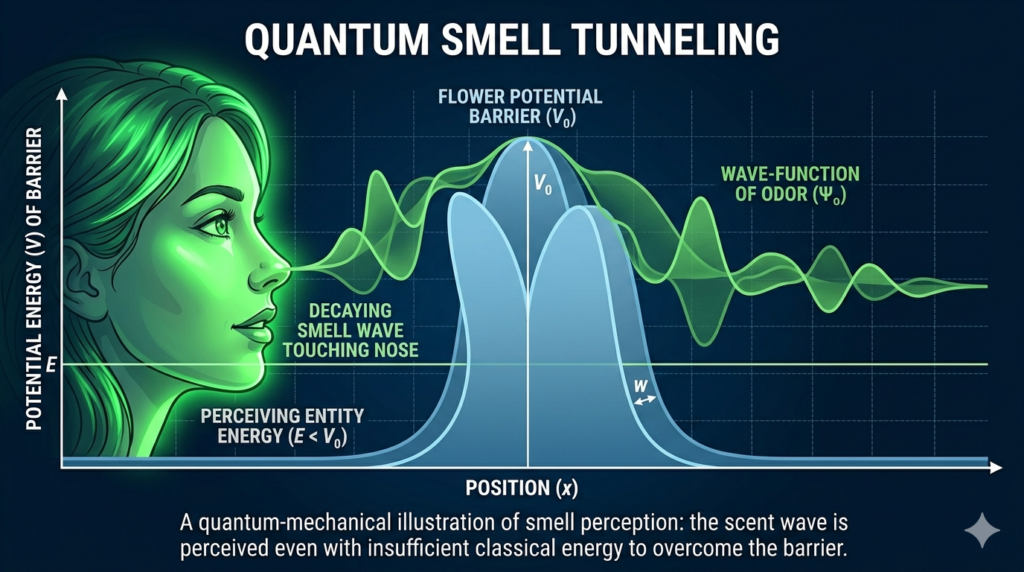
The most difficult question for the Vibration Theory was how. How can a biological protein “measure” a subatomic vibration? The answer lies in Inelastic Electron Tunneling (IET).
In the classical world, if an electron wants to move from point A to point B but a barrier is in the way, it simply stops. However, in the quantum world, electrons behave like waves. If the barrier is thin enough, the electron can “tunnel” through it—essentially appearing on the other side instantaneously.
In our olfactory receptors, researchers believe there is a “gap” through which an electron wants to flow. Under normal circumstances, it can’t jump the gap. But when an odorant molecule falls into the receptor site, it bridges that gap. If—and only if—the molecule’s internal vibration matches the energy difference required for the electron to jump, the electron “tunnels” through the molecule to the other side.
This flow of electrons acts like a switch. The “tunneling event” triggers the G-protein coupled receptor, which then fires an electrical pulse to the olfactory bulb in the brain. In this model, the scent molecule isn’t a key; it’s a bridge that allows a quantum current to flow.
The “Smell of Heavy Water” Experiment

The strongest evidence for this quantum mechanism comes from the study of isotopes. Isotopes are atoms that have the same number of protons (same shape/chemistry) but different numbers of neutrons (different mass).
If you replace the Hydrogen atoms in a scent molecule with Deuterium (a heavier isotope of hydrogen), the shape of the molecule remains identical. However, because Deuterium is heavier, it vibrates at a lower frequency—much like a thicker guitar string produces a lower note.
In landmark experiments, fruit flies were trained to distinguish between normal odorants and “deuterated” (heavy) versions of the same molecules. If the “Lock and Key” theory were correct, the flies should have been confused because the shapes were identical. Instead, the flies easily told them apart. They weren’t “feeling” the shape; they were “hearing” the quantum vibration of the atoms.
Quantum Biology: The New Frontier
The idea that a warm, wet biological system like the human nose utilizes quantum tunneling is revolutionary. Usually, quantum effects are only observed in highly controlled, sub-zero laboratory environments. If the Vibration Theory is correct, it means that evolution has found a way to maintain “quantum coherence” at room temperature.
This places olfaction alongside photosynthesis and bird navigation (magnetoreception) as a pillar of the emerging field of Quantum Biology. It suggests that life is not just a series of chemical reactions, but a sophisticated utilization of the fundamental laws of the universe to survive and perceive.
Implications for the Future: The Digital Nose

Understanding the quantum mechanics of smell isn’t just an academic exercise; it has massive implications for technology and medicine.
- Electronic Noses: Current “e-noses” are bulky and often inaccurate because they rely on chemical sensors. If we can replicate quantum tunneling on a microchip, we could create sensors capable of “smelling” diseases like cancer or Parkinson’s on a patient’s breath with 100% accuracy.
- Perfumery and Flavor: Scientists could design entirely new molecules that don’t exist in nature but vibrate at the exact frequency of “rose” or “sandalwood,” revolutionizing the fragrance industry.
- Artificial Intelligence: By decoding the “vibrational alphabet” of scents, we can teach AI to categorize every possible smell in the universe based on its frequency spectrum rather than trial and error.
Conclusion: A Particle Accelerator in Your Face

The next time you peel an orange or walk through a pine forest, consider the “Empirical Archive” of your own senses. You aren’t just catching floating bits of fruit or wood in your nose. Instead, you are hosting a series of subatomic events.
In your olfactory receptors, electrons are vanishing and reappearing, tunneling through molecular bridges to translate the “music” of chemical bonds into the symphony of scent. Our noses are, in essence, biological particle accelerators, proving once again that the deeper we look into life, the more we find that the universe is far more “spooky” and interconnected than we ever imagined.
Note for the Reader: While the Vibration Theory remains a subject of intense debate among scientists, the evidence for quantum tunneling in biological systems continues to grow, challenging us to rethink the boundary between physics and life itself.




Leave a Reply to Dev lee Cancel reply