Archaeology · Artificial Intelligence · Ancient Languages
When Machines
Learn to Read Cuneiform
A new AI tool called Palaeographicum is rewriting how scholars unlock 4,000-year-old secrets pressed into clay — and it’s already saving researchers thousands of hours of painstaking work.
Deep in the archives of the world’s great museums — from Berlin to Istanbul, from London to Chicago — tens of thousands of broken clay tablets sit in silence, their wedge-shaped inscriptions holding the bureaucratic records, royal decrees, prayers, and myths of a civilisation that once dominated the ancient world. These are the cuneiform tablets of the Hittites, and for decades, reading them at scale has been a slow, scholar-by-scholar, fragment-by-fragment endeavour.
That is beginning to change. Researchers at Germany’s University of Würzburg, in collaboration with the Academy of Sciences and Literature in Mainz, have unveiled a groundbreaking artificial intelligence system named Palaeographicum — a tool that can scan digitised photographs of clay tablets, identify the unique handwriting style of individual scribes, and search millions of ancient signs in mere minutes.
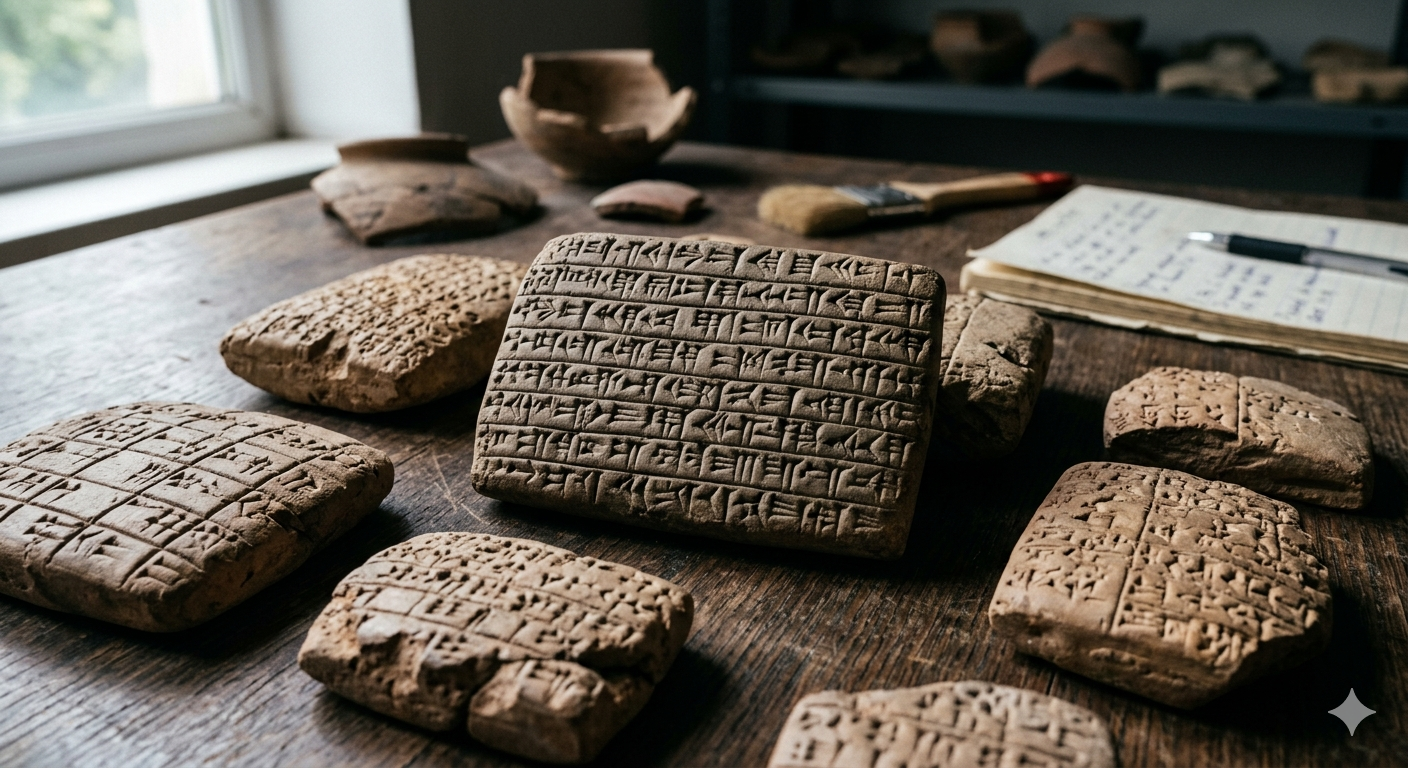
Decorative reconstruction of Hittite cuneiform sign-groups — each wedge was pressed with a stylus into wet clay
The Problem of the Shattered Archive
The Hittites dominated Anatolia — modern-day Turkey — and much of the Near East between roughly 1600 and 1200 BCE. They fought Pharaoh Ramesses II to a standstill at the Battle of Kadesh, negotiated what historians consider the world’s first known peace treaty, and left behind a rich literary and administrative corpus. But the physical record of that civilisation is fragmented — quite literally.
Thousands of clay tablets broke apart over millennia, and their fragments are now scattered across museums on multiple continents. To reconstruct a complete text, scholars must match broken edges, identify which scribe wrote which piece, and determine when undated fragments were produced. Comparing the handwriting across just five tablet fragments once took researchers three full days of intensive work.
“The Palaeographicum is radically changing our work; it allows us to save thousands of hours.”
— Daniel Schwemer, Chair of Ancient Near Eastern Studies, University of Würzburg
Artificial intelligence bridges millennia — pattern recognition meets the ancient wedge
What Palaeographicum Actually Does
The tool works by scanning digitised photographs of clay tablets and detecting individual variations in cuneiform signs. Every scribe who worked in the Hittite royal archives at Hattusa pressed the same 375-sign system into clay, but each writer had their own personal style — some pulled the stylus with a slight flourish, others placed signs with distinct spacing. Palaeographicum spots those differences with algorithmic precision.
The current version of the system provides access to 70,000 photographs documenting more than five million cuneiform characters. When a researcher queries a particular sign, the tool searches the entire catalogue for identical or similar examples, extracts them from their source photographs, and arranges them into visual comparison tables — a task that previously consumed days now takes roughly five minutes.
The tool was developed in collaboration with the Technical University of Dortmund, building on the foundation of the CuKa (computer-assisted cuneiform analysis) project, funded by the German Research Foundation (DFG).
Schematic of the Palaeographicum pipeline — from clay to comparison table
Dating the Undatable
One of the most persistent challenges in Hittite studies is the complete absence of dates on any known clay tablet. Unlike Egyptian or Mesopotamian records, Hittite scribes never noted the year of composition. Scholars have traditionally relied on indirect evidence — the type of cuneiform style, the content of a text, the archaeological layer it was found in — to assign rough periods.
Palaeographicum opens a new avenue. Just as handwriting in medieval Europe changed significantly across centuries, cuneiform signs evolved too. By tracking how individual signs shifted in form across a large corpus, the AI can help researchers estimate when a particular fragment was written — potentially allowing scholars to sequence events in the Hittite world with far greater precision than before.
The very name of the tool reflects this aspiration: Palaeographicum is named after palaeography, the study of the historical development of ancient scripts.
Key Facts at a Glance
A Social History Written in Clay
The implications extend well beyond speed. If scholars can consistently attribute tablet fragments to individual scribes, they can begin to reconstruct the professional careers and intellectual output of real, named individuals from the Bronze Age. Which scribes copied royal correspondence? Which ones produced religious hymns? Which worked across multiple archives?
“If we achieve this goal,” Schwemer has explained, “we could obtain a clearer picture of what each scribe produced throughout their career, and we could compile a social history of Hittite written culture.” That would be a remarkable achievement — glimpsing not just the content of ancient documents, but the individual human beings who created them.
A Timeline of Hittite Digital Scholarship
c. 2001
Gernot Wilhelm and Gerfrid Müller launch the Hethitologie-Portal Mainz — the first comprehensive online catalogue of all known Hittite tablet fragments.
~2015–2022
The CuKa (computer-assisted cuneiform analysis) project, funded by Germany’s DFG, begins building the computational foundation for sign-recognition AI.
2024–2025
Collaboration with TU Dortmund enables machine-learning models to distinguish individual scribe hands across thousands of tablet photographs.
May 2026
Palaeographicum is publicly announced — a live AI tool giving scholars worldwide instant access to 70,000 tablet photographs and more than five million searchable cuneiform signs.

Centuries of scholarship — now augmented by machine learning
What Comes Next
The team stresses that the work is far from finished. “We are continuously retraining the AI,” says Gerfrid Müller of the Academy in Mainz, noting that the development team also incorporates feature requests from the global Hittitology community — provided they are technically feasible and broadly useful.
The announcement in the Hethitologie-Portal’s news section spread rapidly through academic circles without any formal publicity campaign. The global response from scholars has been enthusiastically positive — a sign that after years of quiet development, Palaeographicum has arrived at precisely the moment the field needed it.
For the Hittites themselves, history already granted a second chance: their very existence was forgotten for centuries until archaeological discoveries in the late 19th and early 20th centuries shocked the scholarly world. Now, with the help of algorithms that can read their handwriting better than any human eye alone, the secrets they pressed into wet clay 4,000 years ago may finally be ready to speak.
- The Science of Antifreeze Proteins: How Polar Fish And Insects Beat The Absolute Cold

- Magnetoreception: The Hidden Sense That Reads the Planet

- IIT Madras And IISc Bangalore Synthesize First Truly Carbon-Free ‘Sandwich’ Molecule

- Dark Matter And Dark Energy:The Universe’s Biggest Unsolved Mystery

- The Fermi Paradox: Where Is Everybody?




Leave a Reply