From the decree of Ptolemy I to flames of history: A deep dive into the structure and ultimate fate of the universal archive
A Sanctuary of Knowledge
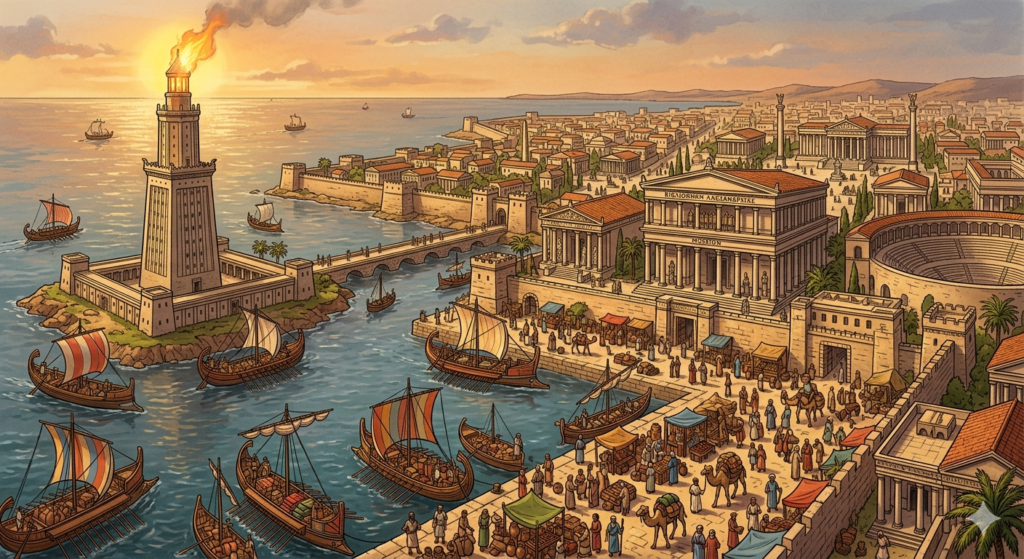
Alexandria was not just a center of trade; it was also a sanctuary of knowledge. The great library of Alexandria, a legendary institution that housed millions of scrolls and manuscripts, attracted scholars and intellectuals from around the world. Here, the minds of the ancient world grappled with the mysteries of science, philosophy, and art, laying the foundations for much of Western civilization.The library was a sprawling complex, its shelves overflowing with the wisdom of the ages. It was a place where ideas were debated, where knowledge was shared, and where the boundaries of human understanding were pushed ever outward. While the library was eventually destroyed by fire, its legacy endures as a testament to the power of intellectual curiosity and the pursuit of knowledge.
For centuries, a singular building on the Egyptian coast held the collective memory of our species. Founded around 283 BCE by Ptolemy I Soter, the Great Library of Alexandria was not merely a building; it was the world’s first true attempt to gather the sum of all human knowledge under one roof. It was a place where the pulse of humanity beat strongest—until it flickered out, leaving behind a silence that still haunts history.
The Anatomy of Knowledge: Structure and Scale
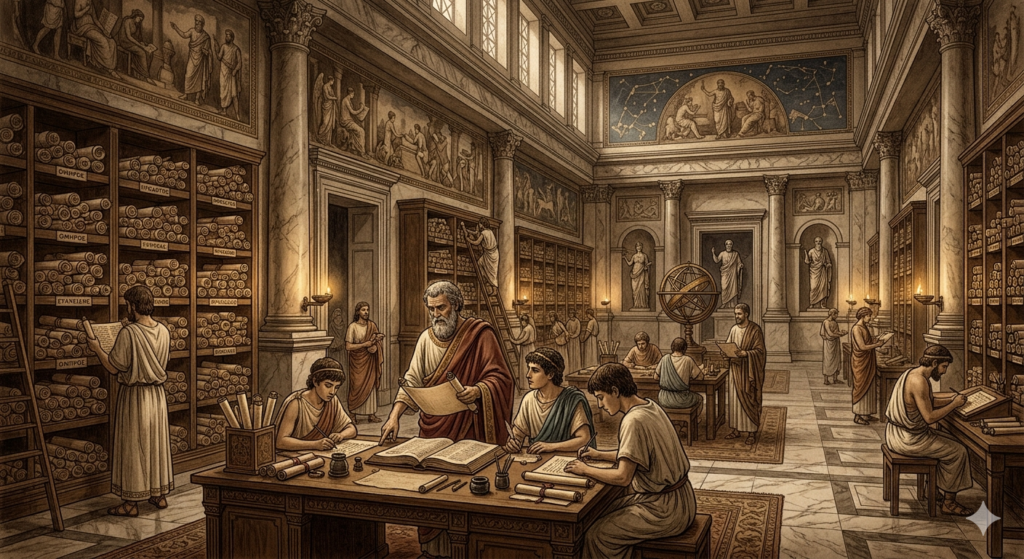
The Library was part of a larger research institution known as the Musaeum (the Temple of the Muses). Far from being a quiet room of dusty shelves, it was a sprawling campus of marble colonnades, lecture halls, and botanical gardens.
At its peak in the 3rd century BCE, estimates suggest the library housed between 400,000 and 700,000 parchment scrolls. This wasn’t just a collection; it was a “universal” library. The Ptolemaic kings were so obsessed with completion that they issued a royal decree: any ship docking in Alexandria was searched. If a book was found, it was taken to the Library, copied by hand, and—in a move of ruthless academic greed—the original was often kept while the copy was returned to the owner.
The Keepers of the Flame
The Library was controlled by the Ptolemaic Dynasty, who saw knowledge as the ultimate symbol of power. They appointed a Head Librarian, a position of immense political and intellectual prestige. Legends like Eratosthenes (who calculated the Earth’s circumference) and Aristarchus (who first proposed the Earth revolved around the Sun) walked these halls.
Handling the scrolls was a monumental task of ancient data management:
- The Pinakes: Callimachus, a famous scholar, created the first library catalog, a 120-volume index called the Pinakes.
- The Scriptorium: A dedicated wing where hundreds of scribes worked tirelessly to translate and preserve works from every known culture—Greek, Egyptian, Hebrew, and Persian.
The Fading Light: A Mystery of Destruction
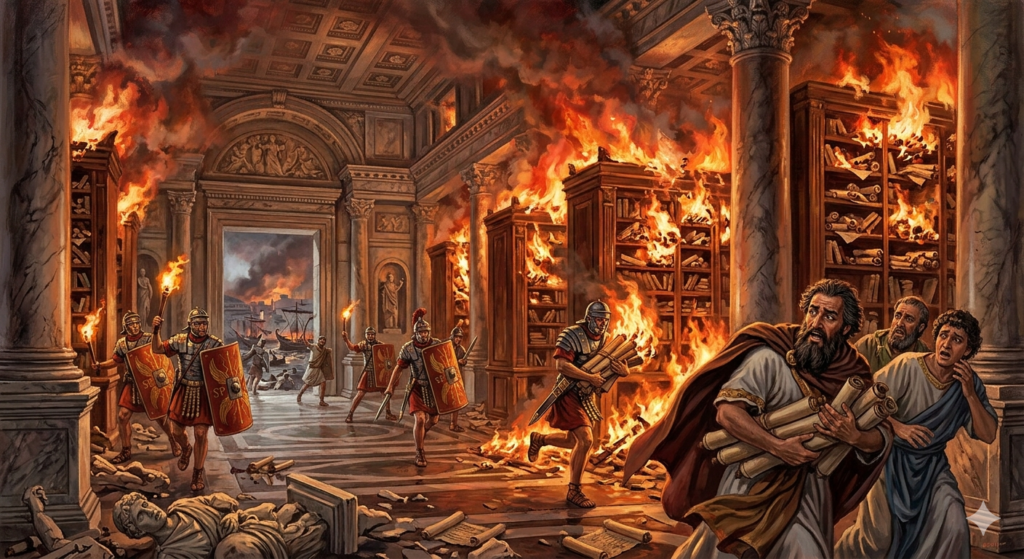
The ultimate fate of the Library is shrouded in historical fog, likely because its death wasn’t a single event, but a slow, agonizing decline. There are four major “suspects” in the murder of the world’s greatest archive:
- The Roman Spark (48 BCE): During the Alexandrian War, Julius Caesar set fire to his own ships to block the harbor. History whispers that the flames jumped the docks and consumed the Library’s warehouses.
- The Religious Purge (391 CE): Emperor Theodosius I banned paganism. A mob led by Bishop Theophilus destroyed the Serapeum (a “daughter library”), viewing the ancient Greek scrolls as heretical threats to the new Christian order.
- The Final Silence (642 CE): When the Muslim Caliphate under Amr ibn al-As conquered Egypt, legend claims the remaining scrolls were used as fuel to heat the city’s 4,000 public baths for six months.
- The Slow Decay: Most historians now believe the “destruction” was also a result of budget cuts and neglect. As Alexandria’s political power waned over the centuries, the scholars left, the roof leaked, and the papyrus rotted away.
The Great Library of Alexandria remains the ultimate “what if” of history. We are left to wonder: if those scrolls hadn’t burned, would we have reached the stars a thousand years sooner? The pulse is lost, but the shadow it cast still defines the modern search for truth.


Leave a Reply