Japan’s Grand Leap:
The MMX Mission to Mars’ Moons
JAXA’s Martian Moons eXploration spacecraft is poised to make history — returning the first-ever samples from Phobos and unlocking secrets of the early Solar System.
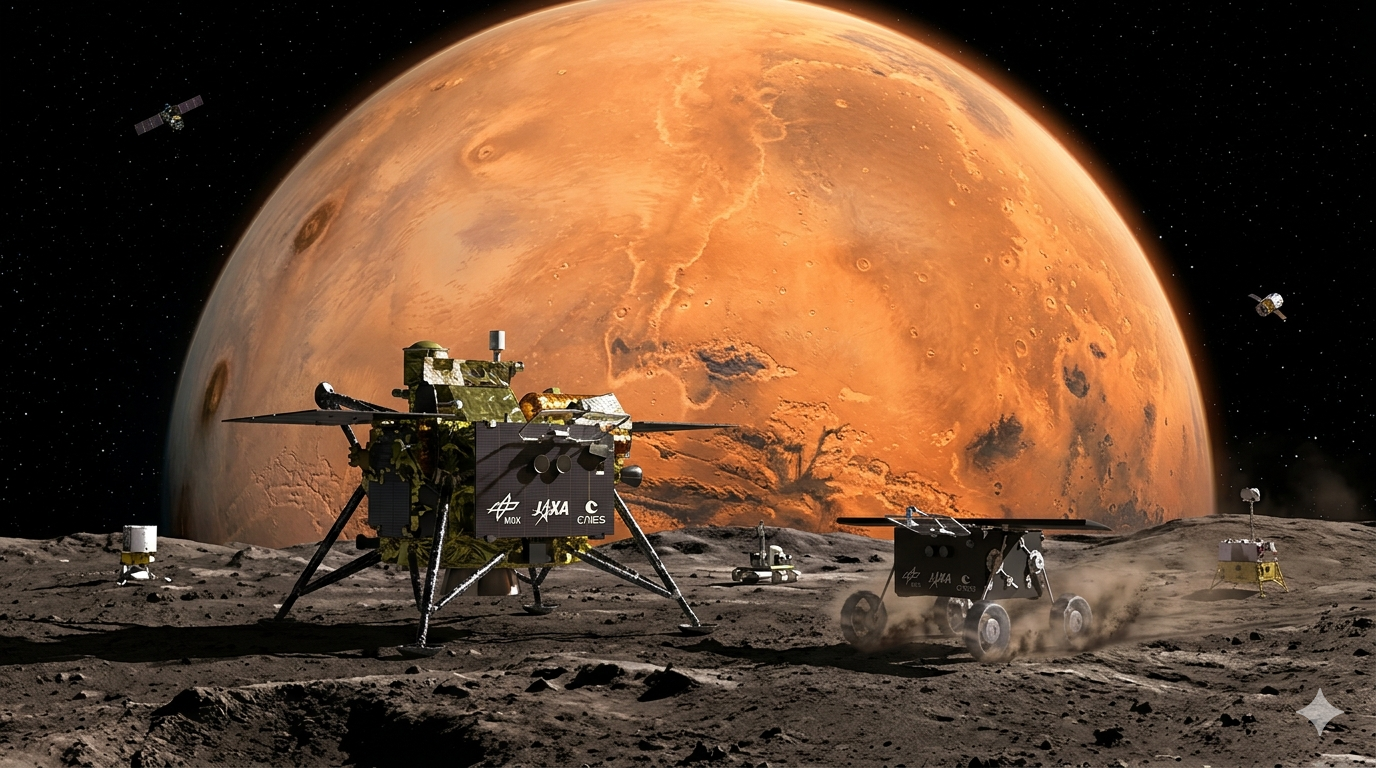
Phobos, the primary target of the MMX mission. Image: AI generated
In November or December 2026, a Japanese spacecraft will lift off from the Tanegashima Space Center and begin one of the most ambitious planetary exploration missions ever attempted. The Martian Moons eXploration (MMX) mission, developed by the Japan Aerospace Exploration Agency (JAXA), is set to travel to Mars, study both of its moons — Phobos and Deimos — land on Phobos, collect samples, and bring them back to Earth by 2031.
MMX will be humanity’s first mission to return material from the region of Mars. The spacecraft will enter a special quasi-satellite orbit (QSO) around Phobos and use two distinct sampling systems — a pneumatic sampler and a coring device — to collect over 10 grams of regolith from its surface. These samples hold the key to one of planetary science’s longest-standing debates: are the Martian moons captured asteroids from the outer Solar System, or are they debris left over from a colossal impact on ancient Mars?
“MMX is humanity’s first attempt to travel to the Martian sphere, land on a moon, collect samples, and bring them back to Earth.”
— JAXA Mission Statement
The mission is a truly global effort. NASA is contributing the MEGANE gamma-ray and neutron spectrometer, France’s CNES is providing an infrared spectrometer (MIRS), and the European Space Agency (ESA) is supplying deep-space communication hardware. A small French-German rover named Idefix, built jointly by CNES and DLR, will be deployed on the surface of Phobos — a first for any mission to a Martian moon. JAXA will also carry an 8K Super Hi-Vision Camera developed with NHK, making Mars the first planet to be imaged in 8K resolution from orbit.
After three years of exploration around Phobos and Deimos, MMX will depart the Martian system and return to Earth, with the sample return capsule expected to land in Australia in 2031. The findings are expected to reshape our understanding of how terrestrial planets — including Earth — formed and evolved over billions of years.



Leave a Reply