How ISRO and JAXA are joining forces to unlock the secrets of the Moon’s South Pole.
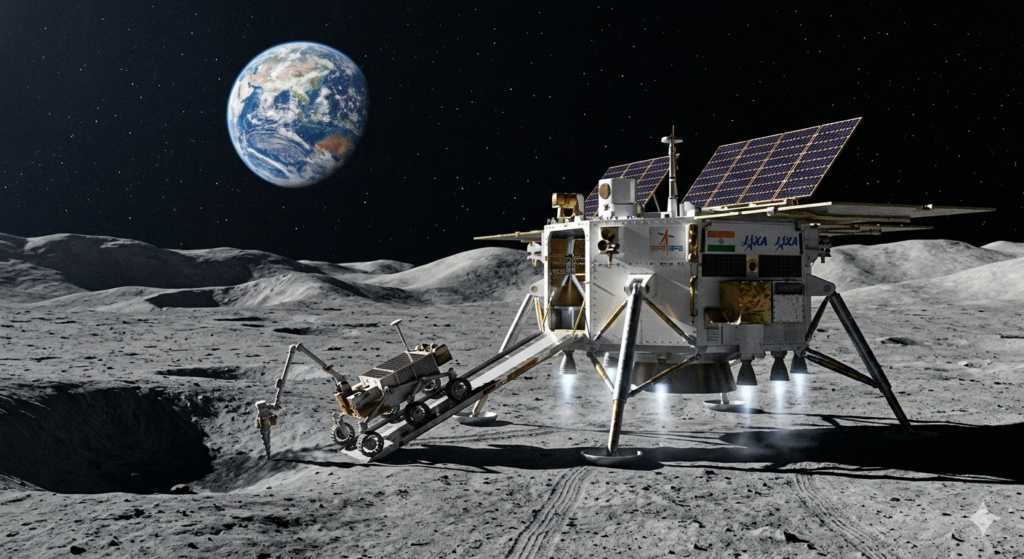
The Moon is no longer just a distant celestial neighbor; it is the next frontier for human settlement. But to stay there, we need water. Enter LUPEX (Lunar Polar Exploration)—a high-stakes, joint mission between the Indian Space Research Organisation (ISRO) and the Japan Aerospace Exploration Agency (JAXA).
Often referred to as Chandrayaan-5 in the Indian context, LUPEX is designed to do what no mission has done before: go deep into the “permanently shadowed regions” (PSRs) of the lunar South Pole to find out exactly how much water is hidden in the dark.
Mission Overview: A Tale of Two Agencies
The LUPEX mission is a masterclass in international collaboration, splitting the massive technical requirements between two of the world’s leading space powers:
The Primary Objective
The mission isn’t just about finding water; it’s about prospecting. LUPEX will evaluate the quantity, quality, and accessibility of lunar water ice. This data is critical for the “In-Situ Resource Utilization” (ISRU) needed for future NASA Artemis missions and potential permanent lunar bases.
The Tech Specs: Breaking New Ground
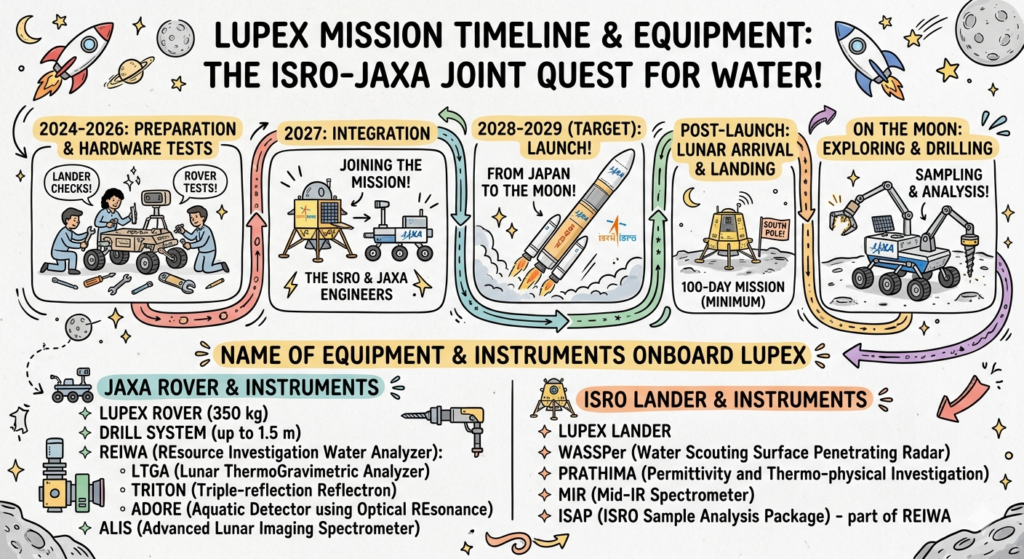
LUPEX will deploy a massive rover (approx. 350 kg) equipped with cutting-edge technology to survive the “Lunar Hell” of the South Pole.
| Feature | Details |
| Landing Site | Moon’s South Pole (80 degree S latitude or higher |
| Mission Life | Minimum of 3.5 months (over 100 Earth days) |
| Drillimg Depth | Up to 1.5 meters to collect subsurface samples |
| Survival Tech | Specialized insulation and heat pipes (no Rhus) to survive the lunar night |
| Payloads | Instrument from ISRO, JAXA, NASA, and ESA |
Key Instruments
- REIWA (JAXA): A suite of analyzers to measure the chemicals in the lunar soil.
- GPR & MIR (ISRO): Ground Penetrating Radar and Mid-Infrared Spectrometers to “see” beneath the surface.
- L9 Engine (ISRO): A newly developed high-precision liquid engine for the lander, which will also serve as a precursor for India’s future crewed lunar landings.
The Timeline: The Road to the South Pole
The roadmap for LUPEX has evolved as both agencies refine their designs to handle the rugged lunar terrain.
- 2017 – 2018: ISRO and JAXA sign the initial agreement and complete feasibility reports.
- 2023 – 2024: Hardware testing begins; ISRO’s Chandrayaan-3 success validates the soft-landing technology.
- 2025: Formal “Implementing Arrangement” signed; ISRO hot-fires the L9 lander engine.
- 2026 – 2027: Final integration and testing of the 6.5-tonne spacecraft.
- **2028 (Estimated Launch): LUPEX is scheduled to blast off from the Tanegashima Space Center in Japan aboard the H3 Rocket.
Why LUPEX Matters
While previous missions confirmed the presence of water, LUPEX will tell us if we can use it. If the mission finds significant ice deposits, the Moon could become a “gas station in space,” where water is broken down into hydrogen and oxygen for rocket fuel.
LUPEX isn’t just a scientific mission; it is the foundation for the next century of space travel. By combining Japan’s robotic precision with India’s cost-effective landing expertise, the “Empirical Archive” of lunar knowledge is about to get its most important chapter yet.
Did you know? The LUPEX rover is designed to climb slopes of up to 25°, allowing it to crawl into craters where sunlight hasn’t touched the ground for billions of years.


Leave a Reply